-
Title
-
Hurrians and Sabarians
-
Creator
-
Ignace J. Gelb
-
Date
-
1944
-
Description
-
Ignace J. Gelb writes that linguistic change has been a principal driver in how ancient peoples vanish from the historical record: the Sumerians, he notes, "lost their ethnic identity" when they abandoned Sumerian for Babylonian, and later the Babylonians and Assyrians likewise "disappeared as a people when they accepted the Aramaic language." Gelb adds that a similar process occurred with the spread of Arabic after the rise of Islam, so that language replacement often corresponds with the fading of earlier ethnic labels in surviving sources.
Taken at face value, Gelb's point is a clear language centred explanation for why names like "Assyrian" drop out of texts: when a population adopts a new vernacular, external observers and documentary traditions begin to call them by different names, and the older ethnonym recedes. This helps explain the apparent "disappearance" of ancient Assyrians from later historical narratives even where people, settlements and cultural practices continued in roughly the same places. Gelb is therefore arguing about how identity is recorded and remembered as much as about biological or cultural extinction.
That said, Gelb's formulation needs nuance if you use it as a description on a website. A shift of language does not automatically mean that a people vanishes in every meaningful sense. Families, religious institutions, local customs and claims of descent can and often do persist through language change. In other words, while the ancient label "Assyrian" may recede in written sources after an Aramaic takeover, communities with clear lines of continuity survived, and their descendants today may legitimately claim cultural, religious and historical connections to the older societies.
-
Language
-
English
-
Publisher
-
Hurrians and Subarians, Ignace J. Gelb, p. VI.
-
archive.org
-
Contributor
-
https://archive.org/details/Gelb1944HurriansSubarians/page/n2/mode/1up
-
Subject
-
Hurrians and Subarians

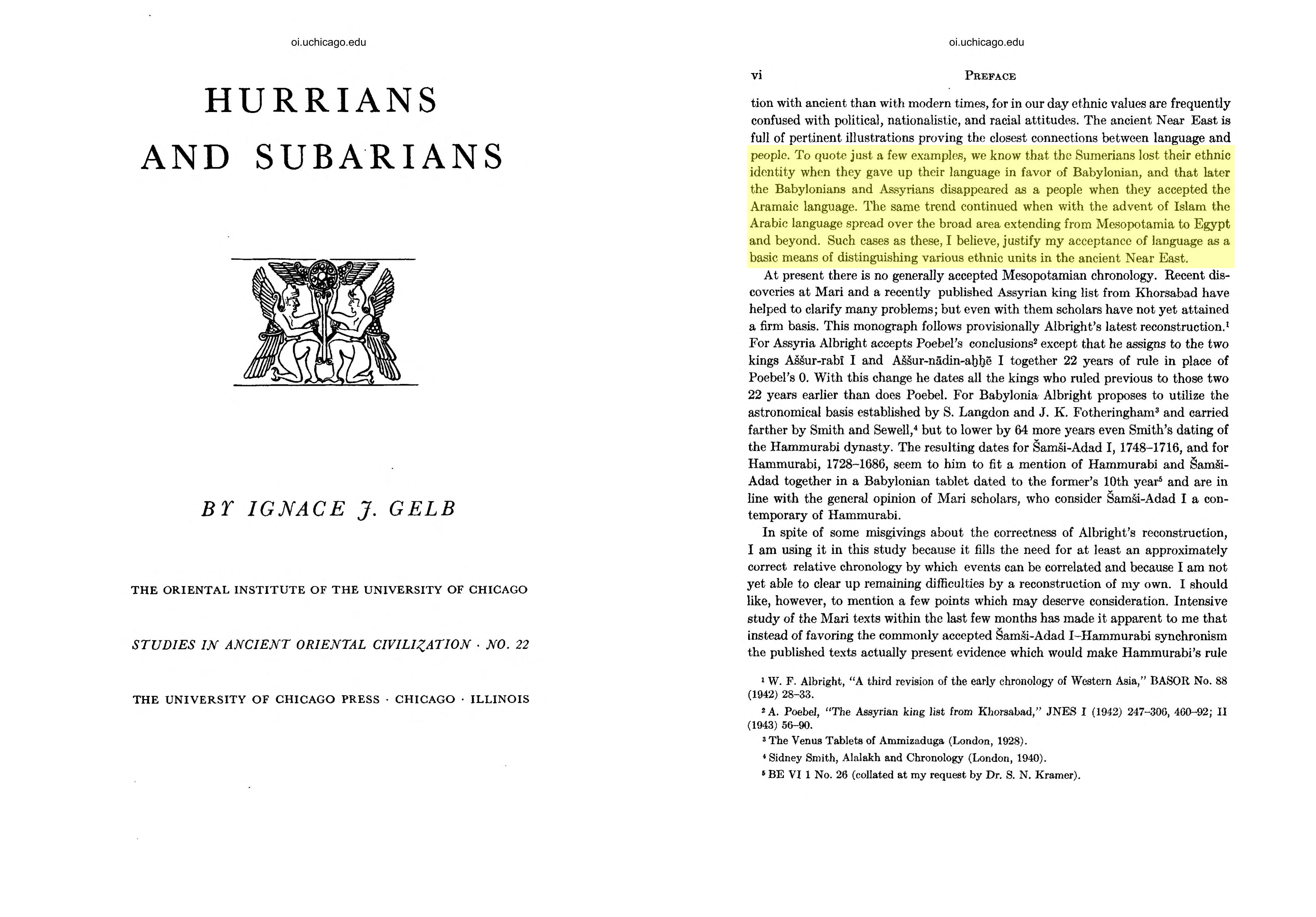
 image (3).png